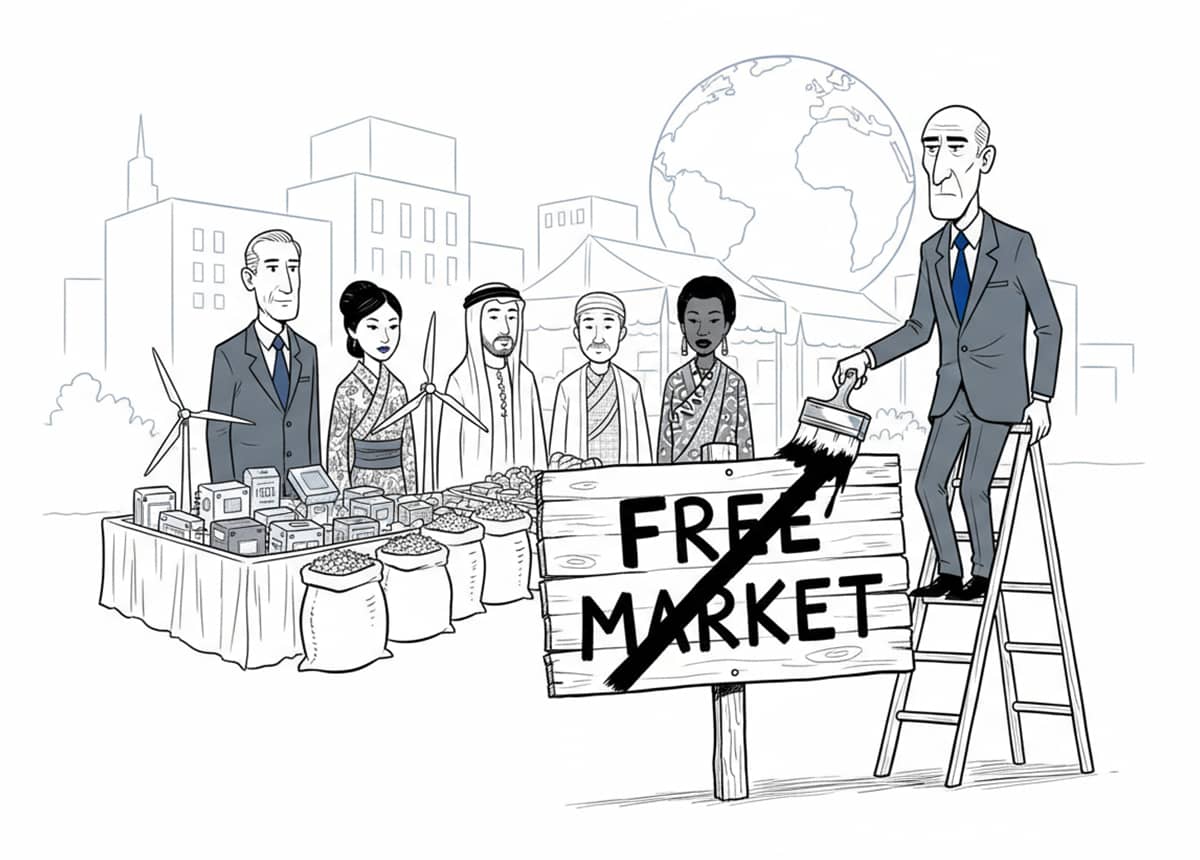
The "Invisible Hand" of the market is no longer working alone; it is now firmly shaken by the hand of the state.
Western nations are pivoting back to aggressive industrial interventions not seen since the late 1970s. That period marked the end of the post-war consensus, as the "Thatcher-Reagan revolution" dismantled state planning in favor of neoliberal deregulation and global trade. This industrial renaissance signifies a shift from pure market efficiency to a "security-first" model, where the state floods sectors deemed vital for national development and existential survival with capital.
The Logic of Massive Subsidies
Modern industrial policy is defined by vast capital injections aimed at reshoring critical supply chains. The U.S. CHIPS and Science Act (2022), with its $280 billion budget through 2026, serves as the gold standard, allocating over $50 billion in direct subsidies to relocate chip manufacturing to American soil. Similarly, the EU Chips Act mobilizes $80 billion to double Europe’s market share by 2030. This mirrors 1970s "Dirigisme" — a system where the state exerts strong direct influence over the economy — but today the focus is on technological sovereignty rather than post-war reconstruction.
The Chinese Benchmark: State Capitalism 2.0
China remains the trendsetter in this shift. Through the "Made in China 2025" initiative, which has already achieved over 80% of its targets, and the "dual circulation" strategy, Beijing has funneled hundreds of billions into "Little Giants" (specialized SMEs) and national champions like SMIC and Huawei. China’s model proves that in a fragmented world, the state acts as the primary venture capitalist and the architect of the industrial ecosystem.
The Russian Response
Russia has accelerated this trend through a total pivot toward technological sovereignty. By 2026, efforts have been consolidated under "National Projects for Technological Leadership" with funding for 2026–2028 effectively doubled. These programs focus on critical sectors: aircraft and shipbuilding, machine tools, and microelectronics. For instance, the transition to domestic software and "heavy" industrial ERP systems is no longer optional; it is a mandatory requirement for all strategic enterprises, backed by multi-billion ruble tax breaks and direct R&D funding.
The Result: Security Over Efficiency
We are witnessing a retreat from hyper-globalization toward a hyper-safety strategy. By prioritizing domestic production of chips and batteries, the West is adopting the very tools it once criticized in the East. The global market is transforming into a collection of "fortress economies" where geopolitical reliability is more important than a low price.