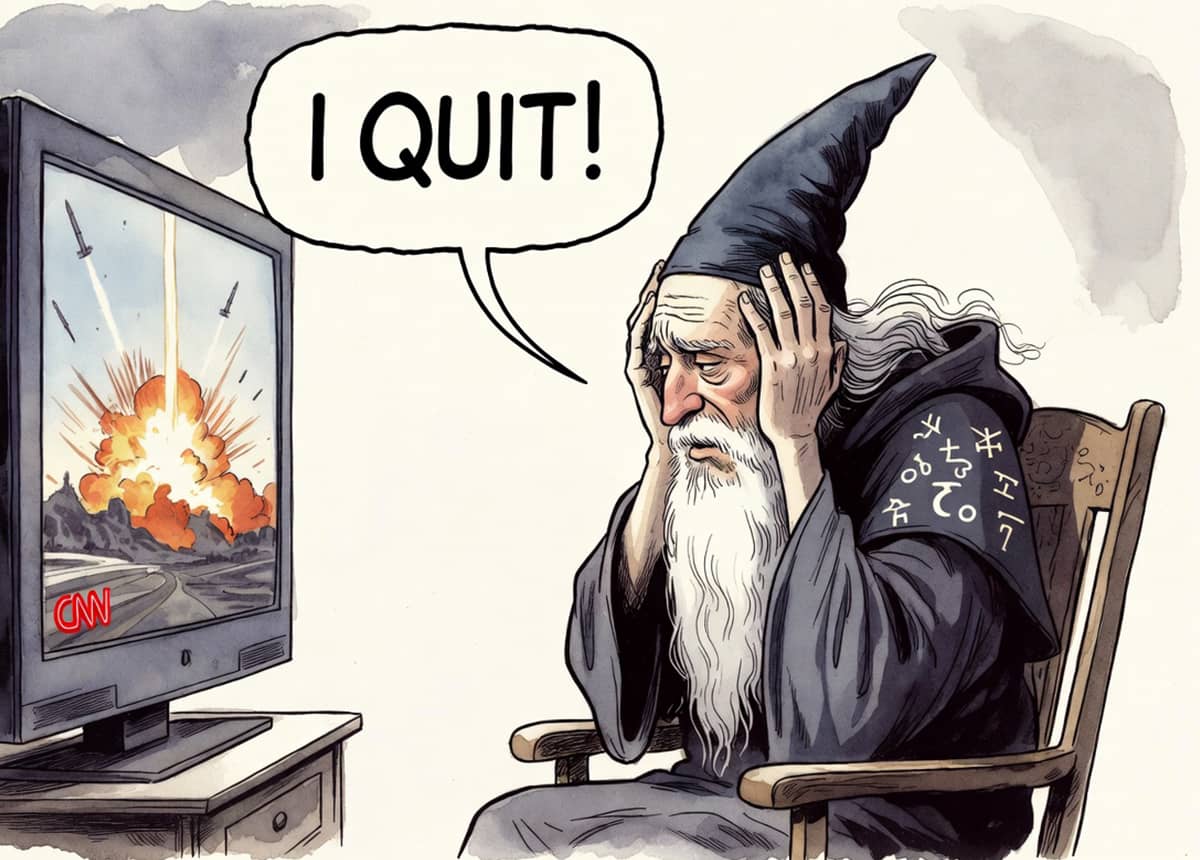
The traditional five-year strategic plan has officially become a historical business artifact — sitting somewhere between the fax machine and the belief in "predictable energy prices"
But then again, did that belief ever truly exist? In the current era of Permacrisis, where pandemics, regional wars, and supply chain collapses don't wait their turn but strike all at once, clinging to a rigid roadmap is no longer "management." It is more like trying to perform heart bypass surgery while riding a roller coaster.
The Illusion of Control
For decades, corporate strategy was the bedrock of a clear, and most importantly, optimistic future. Chief strategists — whether internal management or external consultants — simply looked at the past, added a 5% growth margin, and called it the future. Today, this «future» is shrouded in a dense fog of uncertainty, where «Black Swans» traverse the ocean of risk.
Take the energy sector as a diagnostic case. When an oil major operates in a region like Erbil, Iraq, classic manuals offer no answers. Do you extract, freeze assets, or exit? Sometimes a swift evacuation is the only strategy, as seen in 2014 when ISIS threatened Erbil, or more recently in March 2026, when several firms halted production due to the escalating American+Israeli-Iranian conflict. When local governments are as disoriented as global markets, your "five-year plan" is nothing more than expensive wallpaper. In this environment, the only real strategy is the ability to change your mind faster than the situation changes.
Adapt or Disappear
The difference between survival and becoming a cautionary tale lies in the speed of the OODA Loop (Observe-Orient-Decide-Act): seeing the shift, orienting yourself, deciding on a course, and executing. The winners aren't those with the thickest strategy folders, but those whose business structure is truly modular. If your business cannot lose a "limb" and keep running, it is not built for the thundering 2020s.
BASF, Germany’s largest natural gas consumer, found this out the hard way when their bet on cheap Russian gas failed. Betting on a single geopolitical variable is a fatal mistake in an era of volatility. Meanwhile, companies that treated their supply chains like LEGO sets, rather than monolithic chains, managed to pivot while others were still waiting for the "old normal" to return.
Maersk provides a master class in this maneuver. Instead of remaining a simple port-to-port carrier, they transformed into a global integrator, delivering cargo door-to-door. They realized that in a permacrisis, owning ships isn't enough. You must own the information and the entire chain: warehouses, customs services, and digital platforms. Maersk stopped selling "freight" and started selling "predictability."
While diversification and flexibility have always been parts of the playbook, today they are the vital organs of any serious planning.
Nostradamus 2.0
It is time to stop asking "What will happen?" (Spoiler: eventually, everything will) and start asking "How likely is it?" Modern analytics is not a crystal ball; it is probabilistic forecasting. The goal isn't to be 100% right — that is a trap for amateurs. The goal is to know that there is a 30% chance of a regional conflict and a 15% chance of a sudden (yet expected) trade embargo, and then building a business that doesn't collapse under either scenario. Unlike natural disasters, geopolitical cataclysms can be predicted with reasonable accuracy. You can even keep a 0.02% probability of "world peace" in your calculations — on the off chance we get incredibly lucky and that bet pays off (though defense contractors likely file that number under "Threats").
Long-term strategies are still essential for capital-intensive industries, but they must now be designed with a "double safety margin." It is like building a house in a seismic zone: you don’t know exactly when the ground will shake, you just know that it will.