
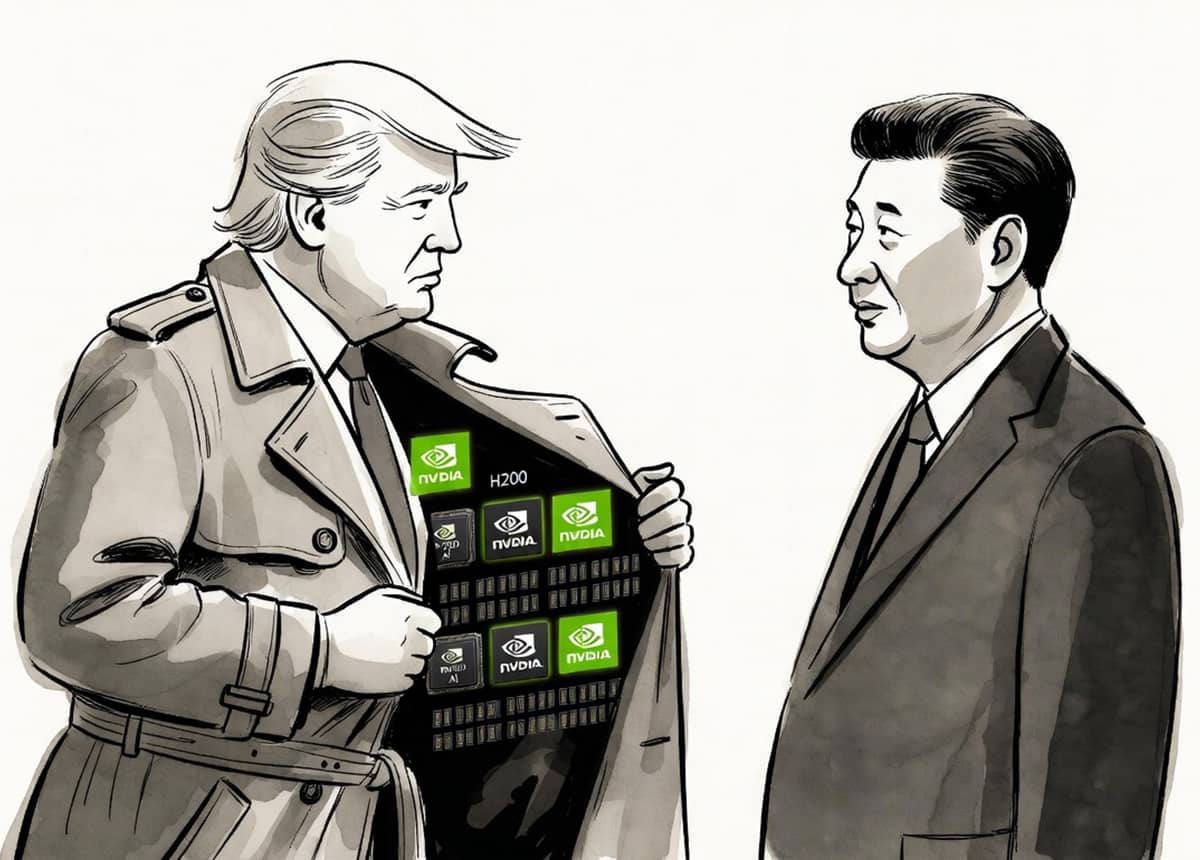
Following the recent US–China bilateral summit in Beijing, China has refused to approve domestic procurement of Nvidia’s H200 AI accelerators.
Summary
Although the White House offered to lift export restrictions in exchange for a 25% fee paid to the US Treasury, the Chinese government blocked its tech giants from placing orders. The proposed deal reportedly involved quotas of 75,000 units for each of five major Chinese tech firms—a volume that would have provided the compute required to train the next generation of advanced frontier AI models. Beijing’s refusal signals a decisive pivot toward strict technological self-reliance, driven by long-term strategic, security, and geopolitical imperatives.
Key Drivers Behind Beijing's Decision
Mitigating External Surveillance and Control: Accepting US hardware under the proposed framework requires the equipment to route through US territory for third-party security audits and physical inspections prior to re-export to China. For Beijing’s state and commercial AI infrastructure, this external verification protocol presents an unacceptable risk of hardware-level vulnerabilities, supply-chain telemetry tracking, or latent remote control by Washington.
Breaking Supply-Chain Interdependence: Reliance on foreign semiconductor architecture leaves China’s tech ecosystem exposed to sudden, unpredictable shifts in Washington’s policy. By freezing Western hardware imports, Beijing forces domestic tech giants—including Alibaba, Tencent, and ByteDance—to redirect capital and infrastructure to domestic chip designers, specifically expanding Huawei’s Ascend ecosystem.
Geopolitical Resilience and Regional Contingencies: Beijing increasingly views advanced AI infrastructure through the lens of national defense. Securing an entirely localized semiconductor supply chain is viewed as a foundational prerequisite for ensuring economic and operational resilience in the event of severe future sanctions or escalation regarding Taiwan.
Strategic Outlook
Beijing’s rejection demonstrates that access to top-tier Western computing power is no longer its primary goal. The Chinese leadership is willing to accept temporary technological bottlenecks in exchange for total sovereignty over its artificial intelligence and semiconductor infrastructure. This stance accelerates the decoupling of the global tech sector, shifting the AI race from a battle over specific software models to a competition between entirely independent, regional hardware ecosystems.