
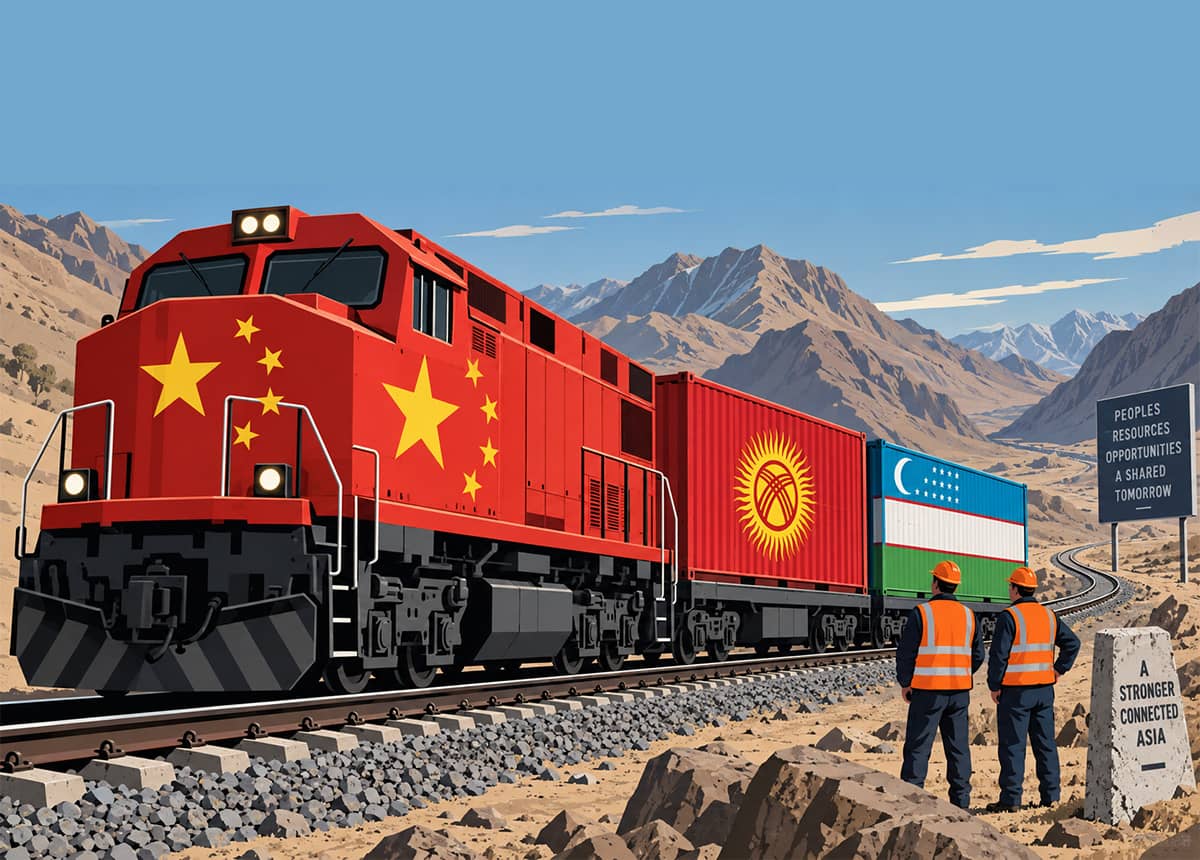
The China–Kyrgyzstan–Uzbekistan (CKU) railway project, which remained in a diplomatic and technical deadlock for nearly three decades, has moved from the stage of memorandums to a phase of active and accelerated construction.
This corridor is far from a local branch; it is a large-scale geopolitical route on the map of Eurasian trade. However, a deep analysis shows that, unlike the panicked headlines of clickbait media, the CKU does not replace existing northern transit routes, but structurally secures and complements them.
Status and Complexity: A Mountain Railway with Two Gauge Standards
Following the signing of a historic trilateral intergovernmental agreement in June 2024, real progress has accelerated sharply. As of the second half of 2026, relevant agencies confirm that about 17% of the total construction work is complete. The route, stretching approximately 530–533 kilometers, runs from Kashgar (Xinjiang, PRC) through the highly challenging high-altitude terrain of Kyrgyzstan to Andijan (Uzbekistan).
The engineering complexity here would surprise even the builders of Swiss alpine tunnels: nearly 40% of the entire route consists of artificial structures—50 bridges and 29 tunnels. Currently, more than 10,000 workers and 7,000 units of heavy equipment are deployed at the sites.
In technological terms, the long-standing and almost sacred dispute over track gauge was resolved through a pragmatic compromise:
- Chinese standard (1435 mm): Used from the border to the Makmal station (Kyrgyzstan).
- Transshipment hub: A large hub is under construction in Makmal, where cargo will be transferred to cars with the Soviet gauge (1520 mm).
Thanks to a high concentration of resources, the ministries of transport of Uzbekistan and Kyrgyzstan now offer highly ambitious forecasts: they plan to complete the work at least a year ahead of the original schedule, in 2029.
Project Financing
The base cost of the central Kyrgyz section is fixed at $4.7 billion. To manage it, a Joint Venture (JV) was established with the following share distribution:
- China: 51% (controlling stake)
- Kyrgyzstan: 24.5%
- Uzbekistan: 24.5%
The financial model relies on a 35-year loan of $2.3 billion issued by a syndicate of Chinese banks (including the China Development Bank and Exim Bank of China) directly to the JV's balance sheet. The remaining $2.35 billion is covered by equity contributions.
Concessional lending for neighbors: To finance its share without pushing the national budget into a debt trap, Bishkek secured an additional $305 million loan from Beijing for 25 years at a symbolic 1.5% per annum. Financial diplomacy in action.
Comparative Analysis: An Addition, Not a Replacement
In Western and some regional analysis, the CKU is often framed as a tool to "bypass Russia" or a "threat to Kazakhstan's transit dominance". This is an analytical oversimplification bordering on naivety. The reality of hard logistics and macroeconomics suggests otherwise: Eurasia desperately lacks transport routes, and the new path will be an important addition to the big picture, but by no means its replacement.
The initial design capacity of the CKU will range from 5 to 8 million tons of cargo per year, with potential growth to 13–15 million tons in the long term. To understand the scale, let us compare the corridors based on current figures:
| Route / Corridor | Current Specifics and Transit Volumes (for 2025–2026) |
|---|---|
| Kazakh Transit (KTZ) | The absolute record holder. In 2025 alone, the transit of Chinese cargo through the Republic of Kazakhstan (RK) reached 20.2 million tons (+32% year-on-year). The trend continues in 2026: in the first half of the year, the RK-PRC rail cargo turnover exceeded 18.7 million tons. The projected capacity of the CKU is only a fraction of what Kazakhstan already carries. |
| Northern Corridor and the RF | The rail container flow between the PRC and the EAEU/EU shows stability. The volume of rail transport between the RK and the RF in 2025 amounted to an impressive 92.1 million tons. Border crossings between RZD (Russian Railways) and KTZ plan to increase capacity from 65 to 85 pairs of trains per day in 2026. |
| Middle Corridor (TITR) | Developing actively but hits a bottleneck in the Caspian Sea, where weather hazards and a shortage of vessels increase freight costs and delay schedules. |
| Future CKU Mainline | Shortens the route from China to Europe by 900 kilometers, saving up to 7–8 days in transit. |
What About Astana?
Kazakhstan is not sitting around regretting the success of its neighbors; it is pragmatically expanding its own infrastructure. Right now, in 2026, the construction of the new Bakhty–Ayagoz railway line, stretching about 270–303 km, is in full swing in the east of the country.
This project will open a third railway border crossing with China (Bakhty–Tacheng) by 2028, increasing the throughput capacity between the RK (Kazakhstan) and the PRC (China) by another 20 million tons. Regional players are increasing the overall capacity of all Eurasia, acting on the principle of a complementary matrix.
Conclusion: Central Asian Resilience in an Era of Turbulence
The main value of the CKU for the region is the long-awaited transformation of Central Asia from a land-locked bottleneck into a key land-linked transit hub.
Against the backdrop of a global geopolitical rift, the region's capitals demonstrate mature pragmatism. They skillfully leverage the natural competition between major powers to build physical infrastructural resilience. The emergence of an additional southwestern corridor insulates the region from unilateral logistical disruptions, guaranteeing economic growth, job stability, and strengthening Central Asia's agency as an independent player.